

How discarded peels inspired a new material for sustainable product design – about Basira Havoli’s thesis.
Each morning, thousands of people in Belgium press their own orange juice at supermarkets like Carrefour or Delhaize. The machine hums, the juice flows, and the peels fall into a bin, out of sight, out of mind. What most people don’t realise is that this everyday act creates around 14 million kilograms of orange peel waste every year in Belgium alone. Most of it is composted or discarded, never becoming more than a sticky side product of our craving for fresh juice.
When Basira Havoli, a recent graduate in Industrial Design Engineering Technology at Ghent University, came across this hidden waste stream, she did not saw rubbish, but potential. Her master’s research explored how these orange peels could be transformed into a functional, bio-based material, using the Biodesign Toolkit, a framework that bridges biology and design thinking. The framework encourages designers to oscillate between human and biological perspectives, allowing the project to grow organically rather than linearly.
Designing with nature, not against it
Biodesign starts from a simple but radical idea: what if designers didn’t just use nature as a resource, but as a partner? Rather than forcing materials to behave a certain way, the process invites the designer to listen, observe, and collaborate with he way nature works. “The material always has a say,” says Havoli. “You can’t completely control it, and that’s part of the beauty.”
Following this philosophy, she began experimenting with orange peel waste from local supermarkets. The peels were dried, ground into powder, and mixed with different natural binders such as pectin and starch, both plant-derived polymers that can hold materials together.
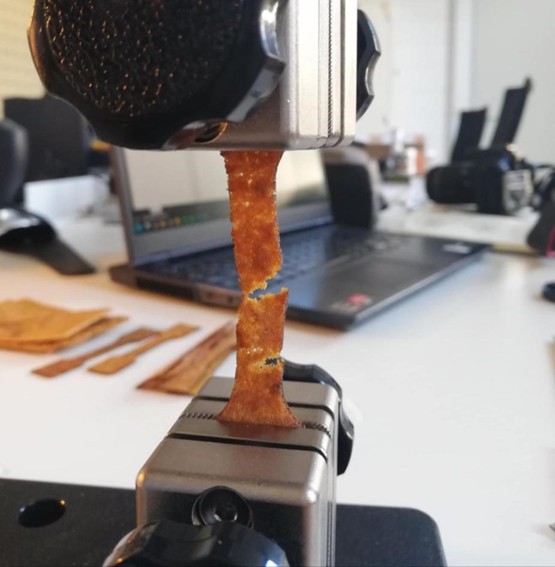
Throughout weeks of trial and error, she tested dozens of compositions, observing how they reacted to pressure, moisture, and heat. “Some batches cracked. Others became too soft,” she recalls. “But every test brought new insights, it was like having a conversation with the material.”
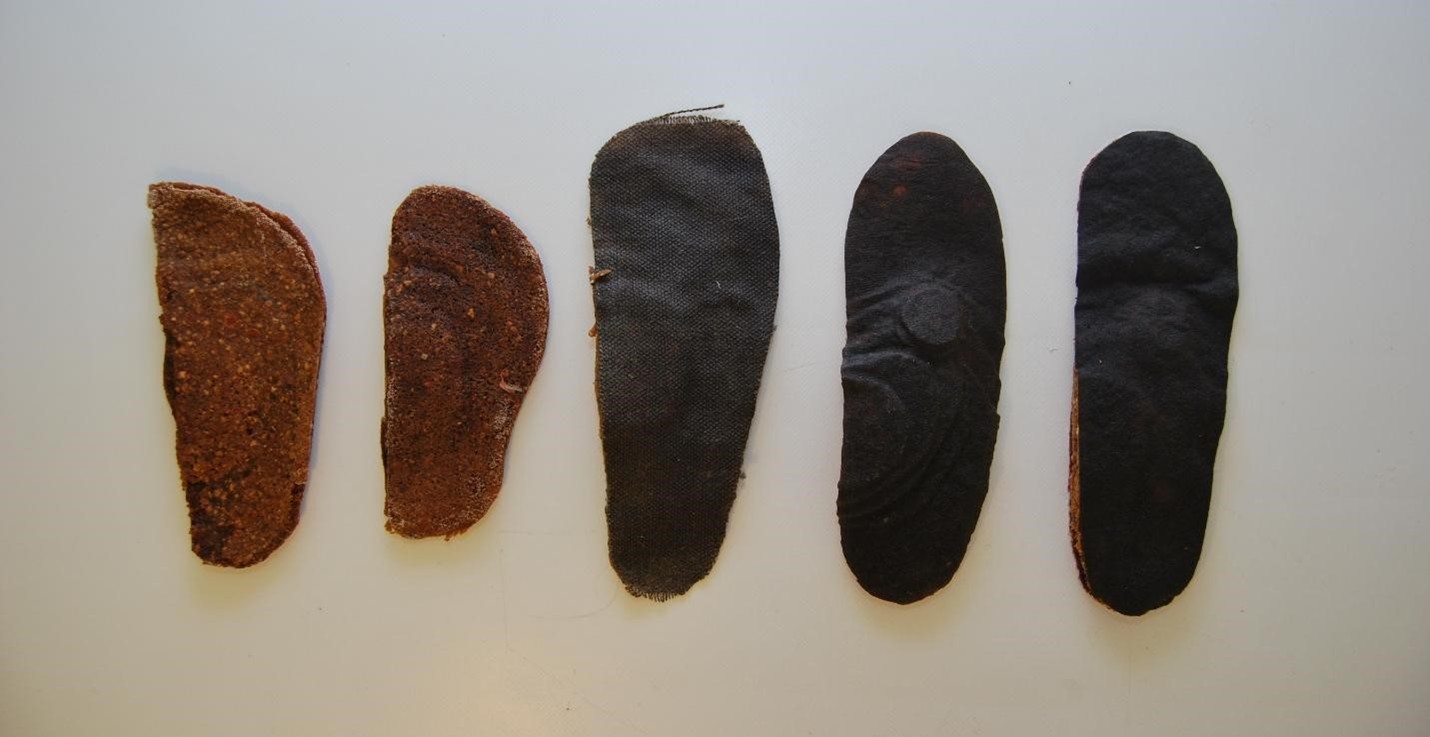
Eventually, one application emerged as a natural fit: arch support insoles, the small, often overlooked inserts that help support the feet inside shoes.
The idea was elegant in its simplicity. Insoles are often made from petroleum-based foams like EVA, which are hard to recycle and end up as landfill waste. What if, instead, they could be made from a biodegradable material derived from local organic waste?
By processing the orange peel powder with a starch-based binder, Havoli produced flexible yet stable sheets that could be moulded into insole shapes. Early prototypes were tested by users, revealing valuable feedback: moisture absorption and softness were issues, but comfort and tactile warmth were surprising strengths.
Over time, refinements followed, layered structures, natural top coatings like cotton and even Urushi lacquer, a traditional plant-based varnish from Asia. The improved versions felt smoother, lasted longer, and held their shape better during daily use.
A small sole with a big impact
The project didn’t stop at the workshop bench. Havoli carried out a Life Cycle Assessment (LCA) to measure environmental impact compared to conventional insoles.
The results were striking: the orange peel prototypes reduced CO₂ emissions by up to 85% over a two-year period. Even if users needed to replace them more often, the local sourcing, low-energy production, and compostable end-of-life made the design far more sustainable.
This finding ties into a larger discussion within circular design. True sustainability is not just about replacing materials, but rethinking value itself, turning what we throw away into something meaningful and functional. As Havoli puts it: “The goal isn’t to make something ‘eco’ for the sake of it. It’s to make something that performs well because it’s connected to its natural origin.”
The ethics of waste
During her research, Havoli also explored the ethical dimensions of working with waste. “Upcycling” sounds good on paper, but what happens if a waste material becomes so desirable that companies start producing waste on purpose? This paradox, known as the rebound effect, challenges designers to think beyond aesthetics and novelty.
Her approach remained grounded in locality and transparency. By sourcing peels directly from nearby juice machines and experimenting in small batches, the process avoided industrial-scale extraction. “The moment you depend on waste as a commodity, you risk losing sight of regeneration,” she explains. “It has to remain about giving back, not taking more.”
Biodesign embraces unpredictability. In many ways, Havoli’s process mirrored natural evolution: try, adapt, test, and evolve again.
There were failures, prototypes that dissolved in humidity, materials that warped overnight, but also breakthroughs that wouldn’t have emerged from a purely technical mindset. This hands-on, iterative design process is at the heart of the Biodesign Toolkit, developed by Ghent University researchers Francesca Ostuzzi and Bert Vuylsteke. For Havoli, the toolkit became both a map and a mentor. “It reminded me to pause and reflect, to ask what the material was trying to tell me,” she says. “Sometimes the best progress came when I let go of control.”
What is next for orange peel design?
While the prototypes still need improvements, especially in lifespan and moisture resistance, the groundwork has been laid for further exploration.
Potential future directions include protective coatings made from plant resins, scaling up through local maker labs, or applying the same approach to other waste streams like coffee grounds or potato skins. Beyond materials, the research also touched on social sustainability, questioning how design can empower communities to see waste differently. “If a supermarket or café can locally reuse its own peels or grounds to make small, useful products, that’s circularity at its most human scale,” Havoli says.
Ultimately, From Orange Residual Streams to Sustainable Innovation is not just about a new material, it’s about a new mindset.
It asks us to slow down and look at everyday by-products with curiosity. It blurs the boundary between designer and scientist, product and organism, problem and possibility. In the long term, projects like this one show that regeneration, not just sustainability, could become the true goal of design.
It’s not only about doing less harm, but about creating systems that heal and renew. And sometimes, all it takes to start that process is to look twice at a discarded peel.